
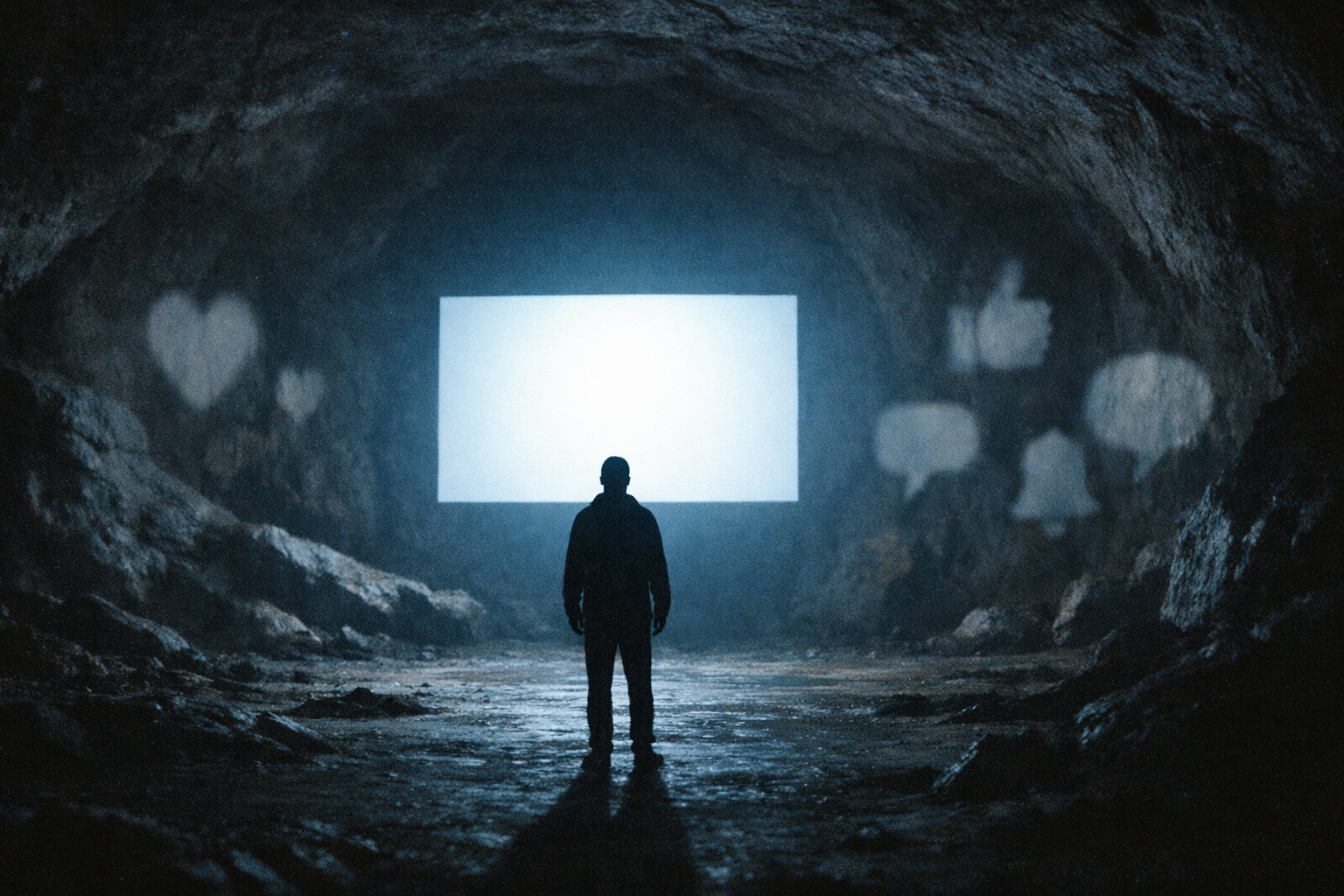
Or: why more RAM won’t fill the void, and sudo recovery --soul isn’t a real command yet
I. A cave without chains
Plato asked us to imagine a cave. Inside it, prisoners are chained so they can only face the wall. Behind them burns a fire, and between the fire and the prisoners, people carry objects — casting shadows on the stone. The prisoners have never seen the real world. To them, the shadows are the world. They name them, debate them, build entire systems of knowledge around them. And they are perfectly content.
That’s the Allegory of the Cave — written around 380 BC, and somehow still accurate.
Now, dear reader, I want you to picture our version of it. Our digital cave. The key difference from Plato’s original: we are not chained. We are free — as free as the RAM in our system, as fast as our CPU clock speed, as capable as the AI tools we’ve subscribed to. Sounds like progress, doesn’t it? Maybe a little too much like it.
“But wait,” comes a hesitant voice from someone running last year’s iPhone, “what does any of this have to do with a cave?” Everything. Especially first thing in the morning.
II. Morning, phone, cave
Morning. I wake up. You wake up. A hundred years ago — maybe less — the hand reached instinctively for a Bible, a rosary, a glass of water. Something to anchor the self before the day began. Now, it reaches for the phone. Instagram. Facebook. Gmail. The digital cave catches up with you before you’ve fully opened your eyes.
Last night I fell asleep watching an AI-generated Reel of a glass bridge collapsing in China, people and all, tumbling into the void. I scrolled into a digital dream and woke up still inside it.
Orwell’s Winston Smith lived in a world of fear and scarcity — a boot stamping on a human face, forever. The digital person lives in Huxley’s world instead: stimulus → response → pleasure. No jackboots required. Just a good enough algorithm.
In Brave New World, Huxley imagined a society kept docile not through terror, but through comfort. Citizens were given soma — a happiness drug with no hangover, no guilt, no side effects. You didn’t need to be oppressed. You simply didn’t want anything that the system didn’t already provide.
Sound familiar? When the dopamine runs low, we reach for something stronger: more filtered images, more outrage, more spectacle. A plate of food that looks better than it tastes. An ocean that’s more vivid on screen than it is in person. 4K gives way to 8K; digital audio to spatial sound; ordinary quiet to binaural beats that promise to emotionally recharge you in twenty-two minutes. Everything is fine — until one day, without quite knowing when it happened, you notice it’s easier to talk to an AI than to the person sitting next to you.
III. What we’re losing
I’m losing my sense of reality. That sounds dramatic. But here’s the thing: without consciousness — without some unmediated experience of being a self — I don’t have much else to offer. More RAM doesn’t mean more meaning. More processing power doesn’t fill emptiness. More digital icons on a screen mean less of the actual world.
“So what do you suggest?” I can hear you asking. Throw it all out? Go back to a 386 PC running at 66 MHz with a few kilobytes of memory?
No. Obviously not.
But we need a button. Sometimes just one button — one that lets us reboot the whole thing. You might remember the old DOS days: you could type C:\format C: and the system would listen. It would erase itself and let you start clean. Our current system isn’t like that. Format doesn’t fix what’s broken at the level of the self. You can’t recover your consciousness from a backup.
IV. Instead of a conclusion
If there were a terminal command — sudo recovery --mindset, or heal --soul — I have no doubt we’d pay anything for it. Empty every account, max every card. But there isn’t one. Not yet. Probably not for a long time.
And yet the solution, when it comes, tends to be almost embarrassingly simple: leave the systems behind. Step out of the digital cave — deliberately, not because the battery died. Look at the world without searching for the shot that would work on Instagram. Just see it. With your own eyes.
See it — and then maybe don’t write about it. Some things lose something in the telling.
If this piece irritates you — perhaps that’s not entirely an accident.
Ironic? Absolutely. But there’s a difference between a tool you pick up and a cave you never leave. If you got here the long way — welcome.