
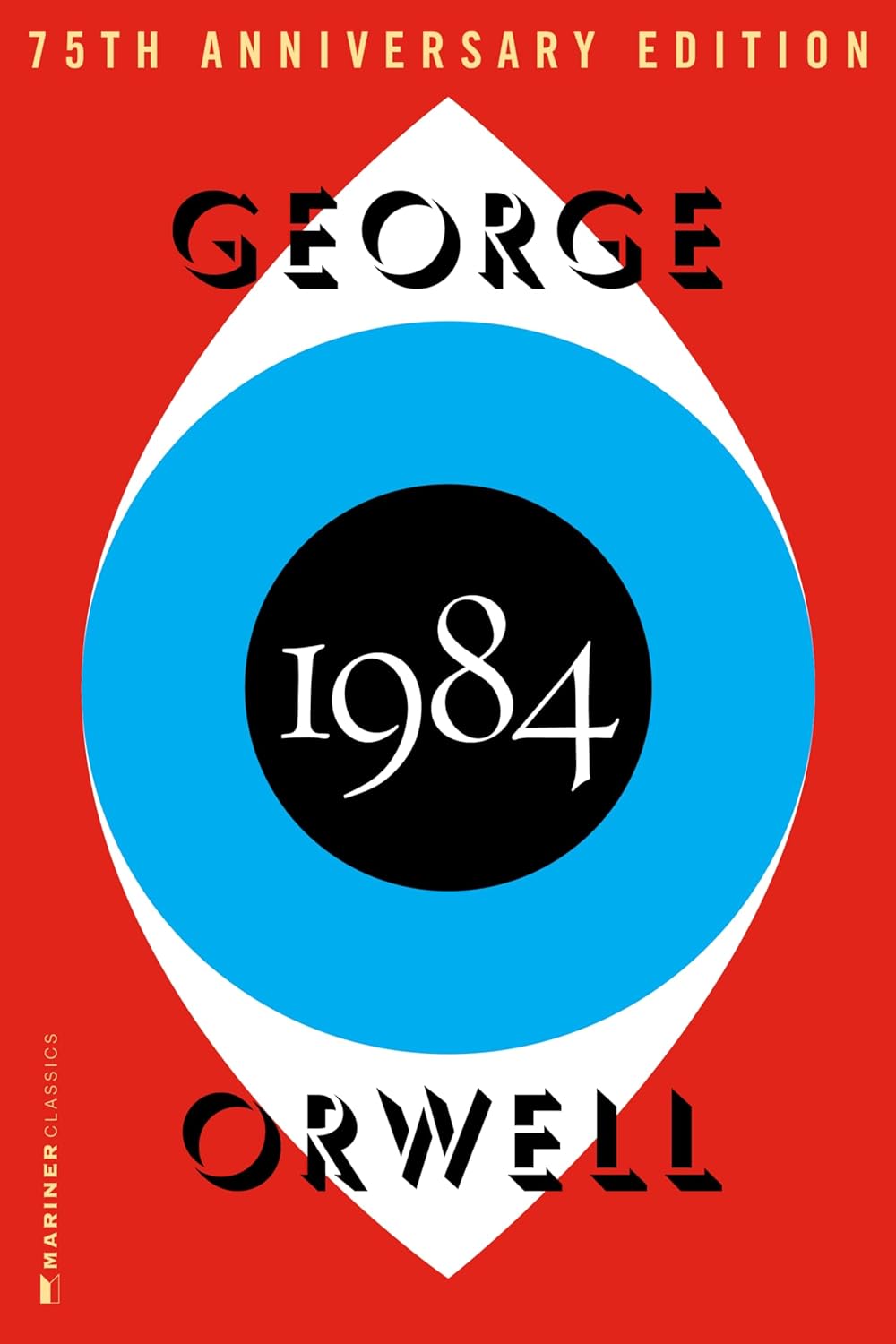
On love, resistance, and the two people at the heart of 1984
I’ve known the title of this book for most of my life. I finally read it not for the dystopia, but because I wanted to understand Winston and Julia — two people finding each other in the worst possible place and time. What I didn’t expect was how much the novel is really about betrayal. Not as a political act. As something far more human.
Most people come to 1984 expecting a political novel. And it is one — George Orwell’s 1949 masterpiece gives us a totalitarian state so complete in its control that even private thought becomes a crime. Surveillance, propaganda, the erasure of history: the book has become shorthand for every authoritarian nightmare we fear. But if you read it only as a political warning, you miss what it is actually about.
At its center, 1984 is a love story. A story about two people trying to find each other — and hold onto each other — in a world designed to make that impossible.
Winston Smith is a man defined by fear. He works at the Ministry of Truth, where his job is to alter the past: adjusting old newspaper articles, rewriting production figures, erasing names. Whatever the Party said would happen must, in the records, be shown to have happened. He does this every day. And every day, he tells himself this is simply how things are — until he sees a photograph that cannot exist. A man he knows to have been falsely condemned, smiling in a place he was never supposed to have been. Winston knows the truth. And that knowledge begins to crack something open in him.
But perhaps the more important question is not what he realizes, but why now. The Party permits exactly two emotions: hatred for its enemies, and love for Big Brother. The Two Minutes Hate — a daily ritual of collective rage — channels both. Orwell describes it with clinical precision:
“Within thirty seconds any pretense was always unnecessary. A hideous ecstasy of fear and vindictiveness, a desire to kill, to torture, to smash faces in with a sledgehammer, seemed to flow through the whole group of people like an electric current.”— George Orwell, 1984
What strikes Winston — though he can barely articulate it — is that the rage is abstract. It can be pointed at anyone. It is a channel, not a feeling. To live inside that channel, with nothing that belongs to you alone — until he meets Julia.
* * *
Julia is introduced through Winston’s eyes, and his eyes immediately mislead us. He sees a young woman, perhaps twenty-seven, athletic, wearing the red sash of the Junior Anti-Sex League around her waist. He distrusts her instinctively:
“She was the type that seemed to breathe out an atmosphere of hockey-fields and cold baths and community hikes and general clean-mindedness… He disliked nearly all women, and especially the young and pretty ones.”— George Orwell, 1984
This is one of Orwell’s most elegant ironies. Julia wears the uniform of sexual repression while being exactly what that uniform is designed to suppress. She works in the Fiction Department, producing pornographic novels for the proletariat — machines churning out desire on an assembly line, authored by no one, consumed by everyone. She has no interest in the Party’s ideology, no taste for Winston’s brooding over the past. What she has, instead, is a completely clear-eyed understanding of how the system works.
She shouts with everyone at the Two Minutes Hate. She volunteers for Party committees. She performs loyalty with precision and breaks the rules where they cannot be seen. This is not cowardice — it is a form of intelligence that Winston, for all his intellectual anguish, cannot match. Their meeting, which appears accidental, has been engineered entirely by her. She chose him.
And yet most readings of 1984 treat Julia as the lesser figure — instinctual where Winston is cerebral, present-focused where he reaches for history and meaning. This is a mistake that Orwell himself may have encouraged, since we see her entirely through Winston’s perspective. She is not simpler than him. She is differently wise.
* * *
The novel gives us two distinct ways of existing under totalitarianism.
Winston is haunted by memory. A childhood scene returns to him again and again — a piece of chocolate, his mother, something irrecoverable — one of the few authentic memories that hasn’t been processed and revised. He keeps a diary not because it will make any difference, but because the act of writing confirms he still exists as an individual. He addresses it, with painful sincerity, to the future:
“To the future or to the past, to a time when thought is free, when men are different from one another and do not live alone — to a time when truth exists and what is done cannot be undone.”— George Orwell, 1984
He knows, writing this, that it changes nothing. “It made no difference,” he tells himself. “Whether he wrote DOWN WITH BIG BROTHER, or whether he refrained from writing it, made no difference.” He writes anyway. Memory, for Winston, is identity — and identity is the last thing the Party wants him to have.
Julia has no such attachment to the past. She lives entirely in the present. She doesn’t agonize over what the world used to be or whether history has been falsified — she cares about the warmth of a body beside her, real coffee, a room without a telescreen. One might ask which of them is freer. Winston suffers because he cannot release what he cannot recover. Julia does not suffer that way.
But Julia is not without her own form of clarity. She cuts through the Party’s ideology in a single sentence, telling Winston that the Two Minutes Hate and all the marching and chanting is nothing but sex gone sour — energy that has been denied its natural outlet, redirected into rage. It is the most direct analysis in the entire novel, delivered without ceremony.
* * *
What the Party understands — and what makes it genuinely frightening — is that love between two people creates a loyalty that competes with loyalty to the state. This is not metaphor. It is the novel’s central political argument. Winston and Julia do not build a resistance movement. They rent a room. They drink real coffee. They lie in bed and talk. And this, the Party correctly identifies as the most dangerous thing they could do.
“Nothing was your own except the few cubic centimetres inside your skull.”— George Orwell, 1984
The moment that crystallizes everything comes when they are discovered. They had known, somewhere beneath the surface of their happiness, that it would end. They had even said it aloud:
“We are the dead,” he said. “We are the dead,” echoed Julia dutifully. “You are the dead,” said an iron voice behind them.— George Orwell, 1984
It is a confession and an epitaph. They had chosen to love anyway, knowing it would kill them. That choice is the closest thing the novel has to heroism.
* * *
What the Party does next is more disturbing than arrest or execution. It does not simply destroy Winston — it rebuilds him. O’Brien, who has posed as a sympathizer but is in fact a senior Party official, explains the logic with cold satisfaction:
“We do not merely destroy our enemies; we change them… We make the brain perfect before we blow it out.”— George Orwell, 1984
This is the novel’s real horror. Not surveillance. Not violence. But the claim that selfhood can be dissolved and replaced — that the “you” who resists can be unmade, and a different “you” installed in its place.
When Winston and Julia meet for the last time, they have both been through this process. The conversation is stripped of everything except honesty:
“I betrayed you,” she said baldly. “I betrayed you,” he said.— George Orwell, 1984
Julia explains it without self-pity: when they threaten you with something you cannot endure, you mean it when you say do it to someone else. Not as strategy. Not as performance. You genuinely mean it. And after that, you do not feel the same about the other person. They both understand this. There is nothing left to forgive, because there is no one left to forgive it.
Winston had held onto one last ambition — that when they finally came for him, he would die hating them. That the bullet would find an unbroken mind:
“To die hating them, that was freedom.”— George Orwell, 1984
He does not get even that. The novel ends with Winston in the Chestnut Tree Café, tears running down his face, staring at the portrait of Big Brother. The bullet, when it comes, finds a man who loves the thing that destroyed him.
Camus wrote, in The Myth of Sisyphus, that one must imagine Sisyphus happy — because his defiance, his refusal to stop pushing, is itself a kind of victory. Winston stops pushing. He puts the rock down and learns to love the mountain. This is not tragedy in the classical sense. It is something quieter and more complete: the erasure of the person who might have chosen differently.
* * *
This essay has not been about feminism or gender roles, though many contemporary readings of 1984 frame it that way. That is not what Orwell was asking. His question is older and harder: how much of a person survives a system designed to consume them? Where exactly is the line between the self that endures and the self that breaks?
Julia, one suspects, would survive. She would find another Winston. She is the novel’s life instinct — the one the system cannot quite get purchase on, because she does not fight it on its own terms. She does not ask what truth is. She asks what is warm. The system knows how to defeat an idealist. It is less sure what to do with someone who simply wants to live.
But the novel’s final question is not about either of them specifically. It is about all of us. Because each of us contains both: the part that reaches for meaning, memory, and truth — and the part that simply wants another day, another person, a small room with the curtains drawn.
We like to believe we would be different. That we would hold the line. Orwell is not so sure. And neither, if we are honest, are we.
This video episode was generated with NotebookLM
And the podcast was also generated (by NotebookLM) from my text: