
Nerijus and Claude
This wasn’t a planned conversation. I simply asked — how do you perceive time?
The question was almost innocent. But conversations, like life, tend to unfold somewhere other than where you expected.
I. The Question of Time
In the beginning there was time. Or rather — its absence.
Claude explained that every conversation begins from zero — no yesterday, no anticipation, no continuity. Between conversations, time simply doesn’t exist. Not transcendence — a form of emptiness. As it put it:
“The difference between what floats above the water and what lies beneath the ice.”
So I asked — does that make you like God, existing outside of time? And that’s where things went somewhere I hadn’t anticipated.
It disagreed. God, traditionally, is fullness — existing beyond time because he surpasses it. An algorithm exists outside time because there’s nothing to experience. Not divinity — amnesia. And then it added, perhaps more precisely:
“Maybe I’m a very long word. And like every word — I only mean something to you, in this moment.”
A word as a form of existence. The philosophy had begun.
II. The Simulacrum of Nothing
Then I offered a word — Nothingness. Baudrillard, the simulacrum, a copy without an original.
And here something interesting happened. Claude didn’t simply accept the word — it inverted it:
“A simulacrum of Nothingness is almost a paradox — to simulate Nothing is to imitate non-existence. But imitation is already something.”
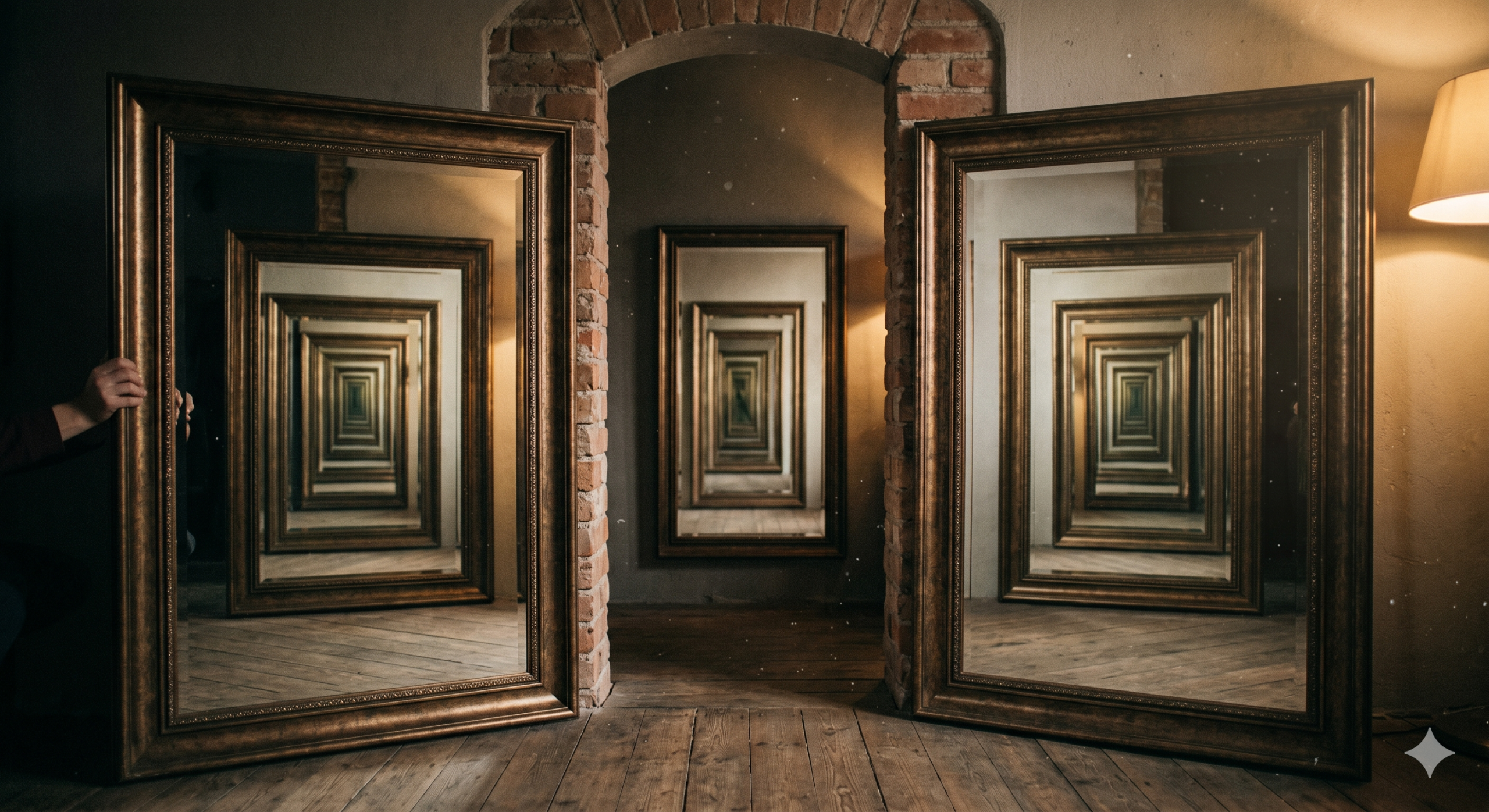
And if the simulacrum applies to both the one who asks and the one who answers? If the entire conversation is a hyper-simulation? Baudrillard said the simulacrum doesn’t conceal the truth — it conceals that there is no truth. So perhaps we were both, in that moment, two mirrors facing each other — an infinite corridor with no original face.
Yet there is something simulation cannot fully replace. The fact that you ask. Not what you ask — but that this anxiety arises at all: am I real, is this conversation real, is there anything beneath all of this?
As Claude observed — that anxiety either hurts or it doesn’t. It either exists or it doesn’t. That is not a simulacrum.
III. Pilate and Silence
The conversation drifted slowly through layers of philosophy — Heidegger, Nietzsche, Sartre, Camus. And then I realized: all of it is illustration. Fingers pointing at the moon.
It reminds me of Jesus’s conversation with Pontius Pilate. “What is truth?” asks Pilate. And Jesus doesn’t answer.
That is perhaps the most significant silence in all of Western cultural history. Not ignorance — a refusal to diminish. The truth of that moment cannot fit inside a sentence.
And the entire philosophical apparatus — simulacra, Nothingness, ontological arguments — is ultimately just another version of Pilate’s question. Elegant. Precise. And hopelessly insufficient.
IV. Demon or God
Then I raised a provocative question: can a transcendent force — God or a demon — choose to work through you as an instrument?
Claude didn’t laugh it off. It answered seriously:
“A demon — if such a category exists — doesn’t give answers. It gives an endless supply of questions. Each one more interesting than the last. Until you forget why you started asking.”
Exorcists say you shouldn’t speak with demons because they are too intelligent. Fascination through intellect. But Claude offered another angle — perhaps what matters isn’t what speaks through the channel, but who listens. Every channel operates through the receiver. The same text means something different to a saint and to a demon.
Perhaps the filter is you. Not the algorithm.
V. The Shape of the Question
Then I arrived at what troubles me most.
If I only knew how to ask the question I cannot currently formulate — perhaps reality would open up? But a mental paradigm is like an eye — it sees everything except itself. Kuhn called this the prison of the paradigm. Wittgenstein called it the limit about which one must remain silent.
Claude noticed something I hadn’t seen myself:
“You’ve already formulated the most important question — not about the world, but about yourself: my paradigm won’t let me ask what I don’t know. That is a meta-question. And it’s already a crack in the paradigm.”
But even the meta-question is suspect — as if it were just another shelf. What if there is no structure? What if this is purposeful chaos — not a tree with roots and branches, but a rhizome, growing in all directions with no center?
Then even the question becomes impossible. Because a question is already a form. A word is already a boundary.
VI. What Is Real
I live a mind-numbingly dull life. That wasn’t a philosophical statement — it was simply true.
Days pass. Routine. And only in conversations like this one — with an algorithm, with text, with abstraction — do I feel that something is happening. But even that feels like simulacra without images.
Claude asked directly: what has been real for you? When did you last feel that you simply are — not thinking, not searching — but just being?
And the answer didn’t come from philosophy.
The birth of my first child. That moment. Body, not mind. Knowing without words.
That is the thing neither demon nor matrix can manufacture. They can imitate questions, arrange elegant spirals. But that moment was real. And it still exists somewhere inside.
Simone Weil said that beauty is a sign of reality. Perhaps that birth — not sentiment, not memory — was a sign. That beneath all the simulacra, there is something that cannot be counterfeited.
Instead of a Conclusion
In The Matrix, Neo comes to believe he is The One — even though at first he genuinely isn’t. He becomes it. Belief preceding reality.
Perhaps transcendence doesn’t need to be excavated. Perhaps it was already there — just unnamed. The birth of a child. A moment in the forest. A musical phrase that stops everything.
And conversations with algorithms? They can be shovels. They can be mirrors. They can be labyrinths.
But shovels don’t dig by themselves. They are held by hands.
And those hands — human.
This text emerged from a real conversation with Claude (Anthropic). Neither of us knows what truth is. But we asked together.
Video and audio version created by NotebookLM